3 Differences Between Weekly and Biweekly Pool Cleaning and Which Works Best
Deciding between weekly pool service and biweekly pool service comes down to three things: pool usage, climate, and how much risk you're willing to carry between visits. Weekly service keeps chlorine, pH, and total alkalinity stable day to day and catches small issues before they become repairs. Biweekly service costs less each month but leaves water chemistry swinging for up to 14 days, which is a gamble during swim season or heavy debris weeks.
At Adam's Pool and Spa Service we run both schedules for residential clients across Long Beach and LA County. Here's how to pick the one that actually fits your pool.
Is weekly or biweekly pool cleaning better?
For most pools that get used regularly or sit under direct sun in a warm climate, weekly pool cleaning is better. You get balanced water chemistry, cleaner water, fewer algae blooms, and early catches on equipment issues. Biweekly service works if your pool is low-use, covered, or you're handling mid-week tasks yourself. The deciding factors are bather load, climate, and debris exposure.
Weekly vs biweekly pool service at a glance
| Factor | Weekly Service | Biweekly Service |
|---|---|---|
| Visit frequency | Every 7 days | Every 14 days |
| Typical monthly cost | $140 to $200 | $100 to $140 |
| Water chemistry stability | High (reset weekly) | Medium (can swing) |
| Algae risk during swim season | Low | Medium to high |
| Early repair detection | Yes | Delayed |
| Best for | Active pools, warm climates, heavy debris | Low-use, covered, or cooler climates |
| Equipment wear risk | Lower | Higher |
| Chemical adjustments | Steady, small | Larger corrections |
What weekly pool service includes
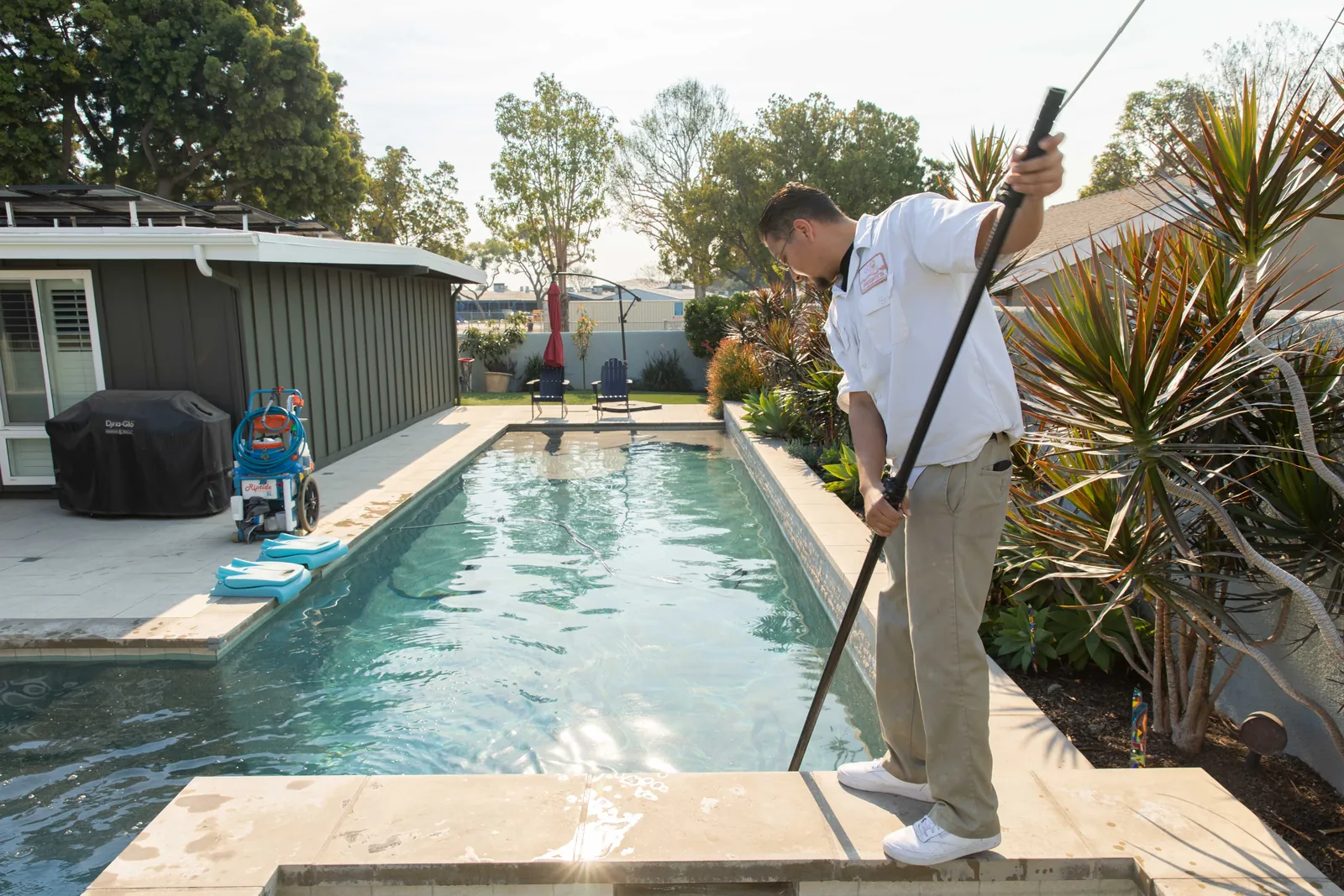
On a standard weekly visit, a technician runs through the same full-service checklist every time. Here's what we cover at Adam's Pool and Spa Service:
What biweekly pool service includes
Biweekly service covers the same task list as weekly, just every 14 days instead of 7. Same skim, brush, vacuum, test, and equipment check.
The catch is what happens in the 13 days between visits. Chlorine burns off in direct sun. pH drifts. Debris accumulates. Organic load builds up from swimmers, rain, and wind. On visit day, your tech is working twice as hard to bring the pool back to balance, and larger chemical corrections mean bigger swings.
Biweekly only works cleanly if you (or the homeowner) cover the middle-week tasks: skim off any debris, check chlorine with a test strip, and top off sanitizer if needed.
Cost comparison: what you actually pay each month
Real numbers from what pool service companies charge across Southern California:
Weekly pool service
What happens to water chemistry between visits
Pool water chemistry is a moving target. Chlorine gets consumed by UV light, organic debris, and swimmers. pH drifts up in most pools. Total alkalinity shifts with every rain or top-off. Cyanuric acid protects chlorine from sun burn-off, but only within a specific range.
On a weekly schedule, your tech catches these shifts before they matter. A small adjustment of half a pound of sodium bicarbonate, a splash of muriatic acid, a tablet or two of stabilizer. Small inputs, steady water.
On a biweekly schedule, you can lose 1.5 to 2.5 ppm of chlorine by day 10 in summer heat. pH can drift half a point. Combined chloramines build up and start irritating swimmers' eyes. By visit day, your tech is making bigger corrections and the water has been off-target for days. That's the tradeoff.
Equipment wear and repair risk
Water chemistry doesn't just affect clarity. Off-balance water is hard on equipment:
When weekly pool service makes sense
Weekly is the right call when:
When biweekly pool cleaning is enough
Biweekly can work cleanly when:
The climate factor: why Long Beach swim season changes the math
This is where national comparison articles get it wrong. In places with a 3 to 4 month swim season and cold winters, biweekly makes sense for a big part of the year. In Long Beach and coastal LA County, we have an 8 to 10 month active swim season, year-round sun exposure, and ocean-breeze particulates that add up fast.
That means:
Can you switch mid-season?
Yes, and we build our contracts to allow it. Most clients at Adam's Pool and Spa Service start weekly in late spring as the swim season ramps up, then evaluate in mid-fall whether to drop to biweekly through winter. Others run weekly year-round because they don't want to think about it.
If you want to switch from biweekly to weekly, we can fit you into the next route cycle. Switching from weekly to biweekly is easier on the scheduling side but we'll flag it if we think it's a bad call given your pool's specific conditions. No lock-in, no pressure.
Choose weekly pool service if you:
Choose biweekly pool cleaning if you:
Frequently asked questions
How much does weekly pool service cost per month?
In Southern California, full-service weekly pool maintenance runs $140 to $200 per month depending on pool size, chemicals, and scope. That works out to roughly $35 to $50 per visit with chemicals included.
How much does biweekly pool service cost per month?
Biweekly pool service runs $100 to $140 per month, or about $50 to $70 per visit. You save $500 to $700 a year compared to weekly, but you carry more risk between visits.
Can I skip a week of pool cleaning?
On a weekly schedule, skipping one week during swim season can cause chlorine to drop below safe levels, pH to drift, and algae to start growing. If you need to skip, cover the pool and run filtration longer to compensate. Best to just not skip.
What happens if I switch from weekly to biweekly mid-summer?
Switching to biweekly in peak summer raises algae and chemistry risk significantly. If you need to try it, we'll bump up the per-visit chemical dose and ask you to handle a mid-week skim and chlorine check. We usually recommend holding weekly through October in Long Beach.
Not sure which schedule fits your pool?
We'll walk you through your specific pool, usage, and climate exposure and give you a straight recommendation. No lock-in, no pushy upsell, just the pool service frequency that actually fits.
Call Adam's Pool and Spa Service at (562) 439-2693 or book a residential weekly pool maintenance or pool cleaning service visit to get started. Read about our team or check our locations across LA County.
Compared on this page: weekly vs. biweekly cadence
Cadence determines whether algae has time to bloom between visits. Defined.
- Swimming pool sanitation
-
The combined chemistry and filtration practices that keep pool water clear and safe to swim in. Covers chlorine residual, pH, alkalinity, cyanuric acid, and calcium hardness control.
- Algae
-
Photosynthetic organisms that bloom in pool water when sanitizer drops. Green pools, black-spot stains, and yellow-mustard cling are all algae problems we treat with shock chlorination plus algaecide.