A Year-Round Seasonal Pool Care Calendar: Month-by-Month Tasks

Algae growth, freeze damage, cloudy water, debris buildup, and heavy-usage equipment strain are the seasonal issues that wreck pools when maintenance slips. Staying ahead means following a rhythm of filtration, shock treatment, and chemical balancing so you get clear water, a safe swim season, and protected pool equipment every month. This month-by-month calendar covers the pool cover, pool surface, filter, pump, and heater across a full 12-month routine, with separate guidance for warm and cold climates.

Most seasonal pool guides divide the year into four buckets. Real pool care doesn't. April looks nothing like June, and November in San Diego looks nothing like November in Cleveland. Adams Pool & Spa built this calendar from 15 years of service routes so you can match tasks to the actual month you're in.

What Is a Seasonal Pool Care Calendar?

A seasonal pool care calendar is a month-by-month schedule of the chemistry tests, cleaning tasks, equipment checks, and timing adjustments needed to keep a pool safe and balanced year-round. The tasks shift with water temperature, UV intensity, bather load, and whether you close the pool for winter.

Warm Climate vs Cold Climate: Which One Applies to You

Warm-climate pools (Southern California, Arizona, Gulf Coast, Florida, Hawaii) stay open year-round. Water temperature rarely drops below 55°F, and swimming continues through most of the calendar. The focus is continuous chemistry, adjusted filter run times, and heater management.

Cold-climate pools (anywhere with sustained freeze) close for winter. The focus is full spring opening, peak summer care, careful fall closing, and winter cover monitoring. If your pipes can freeze, you're on the cold-climate calendar. Pick the model that matches your climate, then use the checklist tables below for the shared weekly tasks.

Month-by-Month Pool Care Calendar (Warm Climate)

This is the calendar for pools that stay open and usable through the full year. SoCal, Gulf Coast, Florida, and similar zones.

January

January

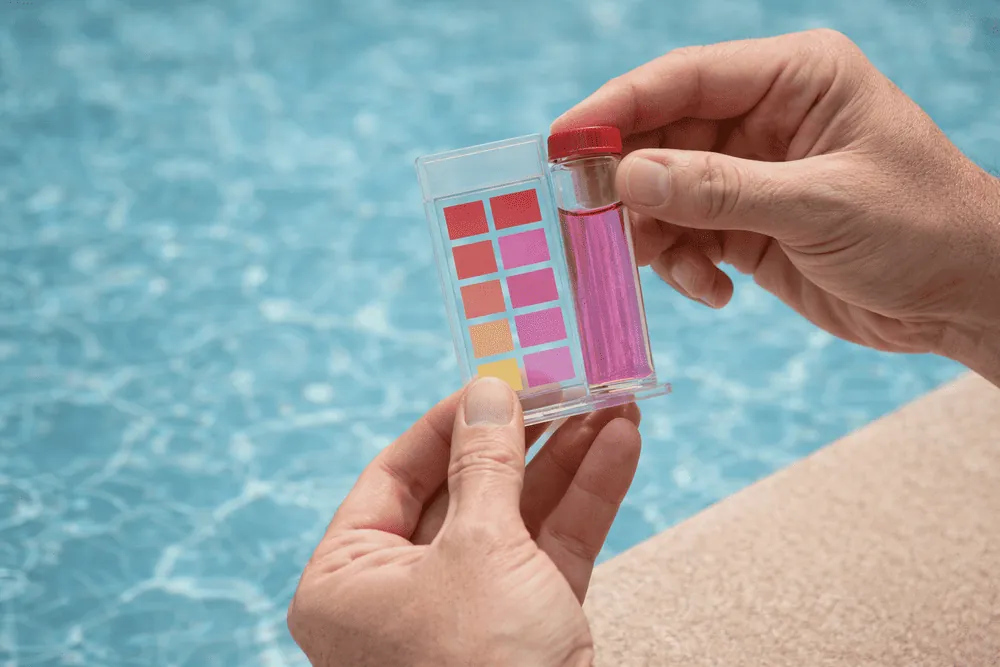
  • Test water weekly. Keep free chlorine at 1-4 ppm and pH at 7.4-7.6 even with no swimmers.
  • Drop filter run time to 4-6 hours per day. Cooler water carries fewer contaminants.
  • Skim debris after any wind event. Empty skimmer baskets.
  • Inspect heater ignition before the first cold-evening use.
February

February

  • Brush pool walls and steps to prevent the first algae film as water warms.
  • Test calcium hardness. Target 200-400 ppm. Hard fill water in the Southwest can drift high this month.
  • Check the pool filter pressure against the clean baseline. Clean if it's 10 psi over.
  • Schedule any equipment repairs now, before spring swim demand hits.
March

March

  • Bump filter run time to 6-8 hours as water temperature climbs.
  • Do a full shock treatment to knock out any early-spring algae spores.
  • Test and balance alkalinity to 80-120 ppm before pH work.
  • Inspect the pump seal and lid O-ring. Lube if dry.
April

April

  • Test water 2 times per week. Chlorine demand rises fast with warmer water.
  • Brush and vacuum the whole pool. Clean the tile line.
  • Verify heater operation for cool-night swims.
  • Review your chemical balancing routine for the swim season.
May

May

  • Filter run time goes to 8-10 hours per day.
  • Test 2-3 times per week. Shock weekly if bather load jumps.
  • Check salt cell output if you're on a chlorinator. Clean plates if scaled.
  • Inspect pool lights and GFCI before summer parties.
June

June

  • Peak season begins. Test 2-3 times per week.
  • Run filter 10-12 hours per day.
  • Shock after any pool party, rainstorm, or heavy use.
  • Backwash sand or DE filter, or clean cartridge. Watch pressure carefully.
July

July

  • Highest chlorine demand of the year. UV burns through sanitizer fast.
  • Verify cyanuric acid is 30-50 ppm. Higher "locks up" chlorine.
  • Brush weekly to keep algae off warm surfaces.
  • Check pump motor temperature. Hot weather + long run times stress bearings.
August

August

  • Keep testing every 2-3 days. Don't coast.
  • Watch for cloudy water after thunderstorms or dust events. Shock and run the filter 24 hours if it develops.
  • Confirm water level stays mid-skimmer. Evaporation is peak this month.
  • Inspect the deck and coping for thermal cracking.
September

September

  • Slightly back off filter run time to 8-10 hours as nights cool.
  • Continue shock treatment weekly. Warm water + lower UV means bacteria still thrive.
  • Clean the salt cell if output is lagging.
  • Check heater operation before fall swim use.
October

October

  • Filter run time drops to 6-8 hours.
  • Start removing falling leaves daily. Debris is the number-one water quality killer this month.
  • Brush and vacuum every 2 weeks at minimum.
  • Test pH weekly. Cooler water + organic load can push pH around.
November

November

  • Filter run time drops to 4-6 hours.
  • Test water weekly. Maintain full free chlorine even with light usage.
  • Clean the filter thoroughly before reducing run time. A dirty filter running short hours grows algae.
  • Check the pool pump and heater for wear before the slow season.
December

December

  • Minimum 4 hours of filter run time, more if nights are warm.
  • Keep chlorine at 1-3 ppm. Don't let it crash just because nobody's swimming.
  • Cover the pool during storms to keep debris and runoff out.
  • Schedule a pro inspection if you've noticed any issue you want to address before spring.

Cold Climate Quick Reference

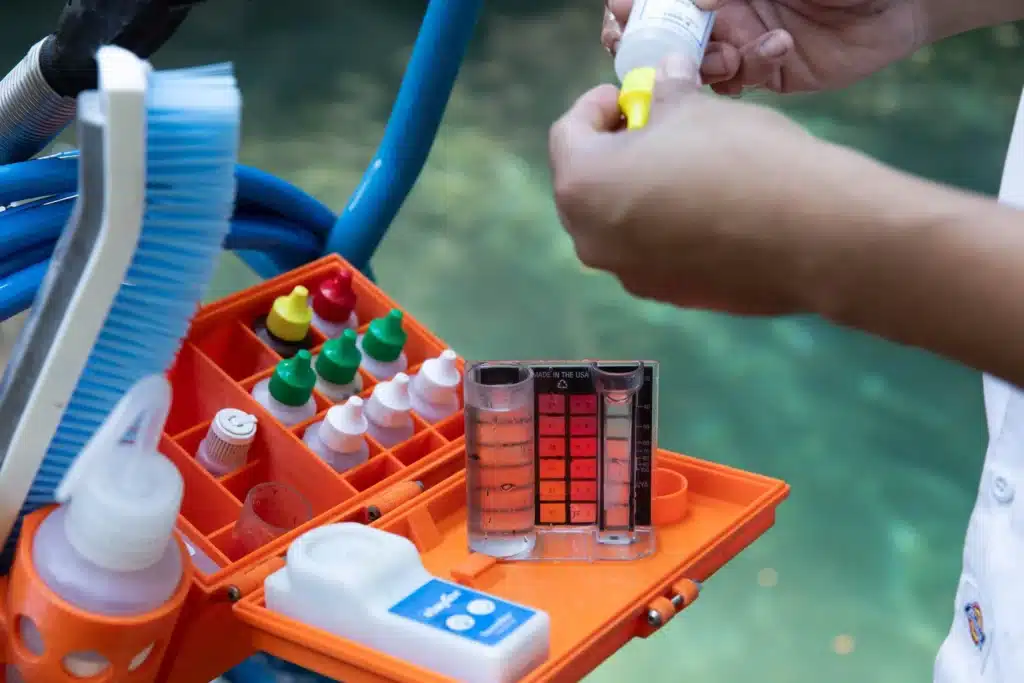
Hands holding a tablet near blue and orange pool service tools on grass

If your pool closes for winter, here's the condensed timeline.

March: Order opening supplies. Inspect cover for tears.
April: Pool opening. Remove and clean cover, refill to mid-skimmer, reconnect equipment, shock, balance, run filter 24 hours.
May: First full shock treatment. Test 2x per week. Brush and vacuum.
June-August: Peak summer rules. Test 2-3x weekly, shock weekly, filter 10-12 hours.
September: Start winterization prep. Order winter cover and closing kit.
October-November: Pool closing. Balance water, shock, drop water below skimmer, blow out plumbing lines, add winterizing chemicals, install cover.
December-February: Monitor cover weight from snow. Pump off standing water. Check chemistry once mid-winter if you have a mesh cover.

Year-Round Weekly and Monthly Checklist

Frequency Task
Daily (summer) Skim surface, empty skimmer baskets, check water level
2-3x per week Test free chlorine and pH
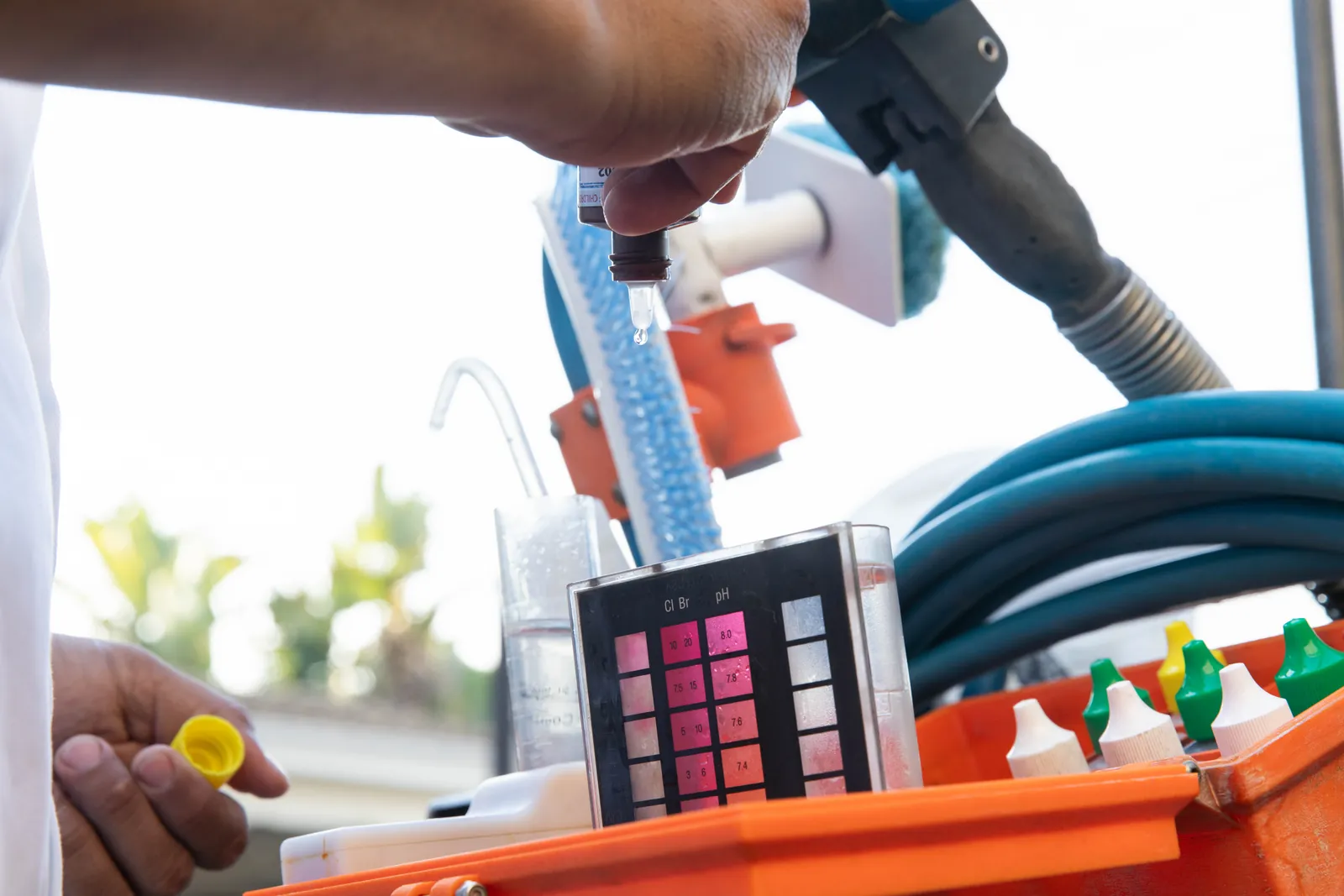
Weekly Brush walls, vacuum, full chemistry test (alkalinity, chlorine, pH, CYA)
Weekly Shock if bather load warrants, especially in summer
Monthly Check calcium hardness, clean skimmer weir, inspect equipment pad
Quarterly Deep-clean filter, inspect heater and pump, check salt cell
Annually Professional inspection, resurface or retile if needed

Chemical Targets and Filter Run Times

Keep these numbers taped to the equipment pad.

Free chlorine: 1-4 ppm
Total alkalinity: 80-120 ppm
Calcium hardness: 200-400 ppm
Cyanuric acid: 30-50 ppm
Salt (if saltwater): 3,000-3,500 ppm
Summer: 8-12 hours per day
Spring/fall: 6-8 hours per day
Winter (warm climate): 4-6 hours per day
Winter (cold climate, closed): pump off, cover monitored

Common Seasonal Pool Care Mistakes

Hands holding a smartphone with app screen visible, outdoor setting with green water background.

Cutting filter run time below 4 hours in warm months. This is how algae gets a foothold.
Skipping a shock treatment after a pool party. Chloramines build overnight and cause itchy eyes.
Letting pH drift above 7.8 for weeks. Scale forms on tile and inside the heater core.
Not draining plumbing lines before a hard freeze. One cracked return line means jackhammering the deck.
Closing a pool in fall with unbalanced water. You'll open to a green swamp next spring.
Forgetting to clean the saltwater cell. Calcified plates stop producing chlorine long before you notice.

When to Call a Pool Professional

Call a pro for spring openings if you don't trust your plumbing, for fall closings in freeze zones, for any heater issue, for salt cell troubleshooting past the basic clean, and for any structural question (cracks, tile, leaks). A weekly pool maintenance route is the cheapest insurance policy in pool ownership because catching a small problem on a Tuesday costs less than fixing a big one on a Saturday.

Adams Pool & Spa offers full-service pool cleaning, chemical balancing, and equipment repair. We're Jandy Certified and a Pentair Expert Installer, so we handle equipment warranties start to finish.

Seasonal Pool Care in Long Beach, CA

Long Beach and the broader LA County coast are textbook warm-climate pools. Swim season runs basically all 12 months for anyone with a heater, and even unheated pools stay usable eight months a year. The calendar above fits SoCal directly, with one caveat: December and January storms bring Santa Ana debris events that can fill skimmer baskets overnight. Run the filter a little longer after any wind event. If you're in our area and want us to run this calendar for you, call (562) 439-2693, check our service locations, or see the Long Beach page. Learn more about our team on the about page.

Seasonal Care Reference

Terms behind a Long Beach pool's seasonal rhythm

Sanitation, stabilizer, and heater run-time all shift with the season.

Swimming pool sanitation

The combined chemistry and filtration practices that keep pool water clear and safe to swim in. Covers chlorine residual, pH, alkalinity, cyanuric acid, and calcium hardness control.

Wikipedia ↗ · Wikidata ↗

Cyanuric acid

A chlorine stabilizer that protects free chlorine from UV degradation in outdoor pools. Held between 30 and 50 ppm in residential Long Beach pools; over 80 ppm chlorine becomes ineffective.

Wikipedia ↗ · Wikidata ↗

Heat pump

An electric pool heater that moves heat from the air into pool water. Lower operating cost than gas in mild Long Beach winters; longer warm-up time than gas.

Wikipedia ↗ · Wikidata ↗